You can still weigh in on Lowndes County's proposed data center rules
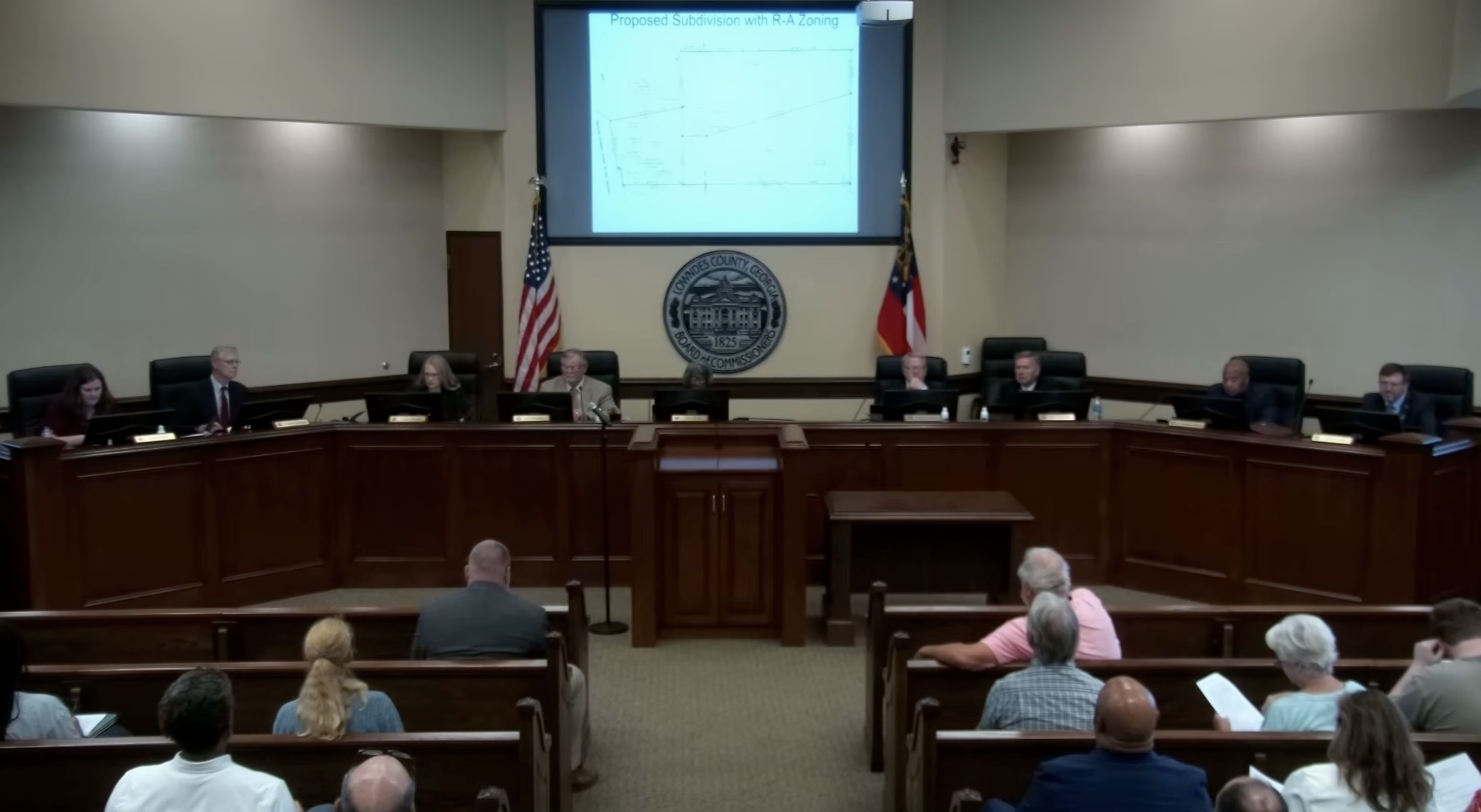
Lowndes County residents have until Nov. 25 to tell county leaders what they think of draft rules for any data center built outside city limits.
The county posted the draft ordinance on its website Nov. 2 and is asking for comments in writing, by email to datacenterordinance@lowndescounty.com. Commissioners are scheduled to vote Dec. 8, "pending any additional changes, review and research direction," the draft's cover sheet says.
The rules would apply only in unincorporated Lowndes County, to new data centers and to expansions of existing ones. Large data centers would be allowed only in industrial zoning districts.
The bigger the building, the stricter the rules. The draft sorts data centers by floor space, from "minor" (under 20,000 square feet) to "hyperscale II" (1 million to 2 million square feet), and size sets how much land a project needs and how far it must stay from its neighbors.
Lots would need at least 20 acres for the smallest size and 600 acres for the largest. Buildings and noisy equipment would have to stay 500 to 1,500 feet from the edge of any residential, rural, commercial, office or institutional district, and at least 1,500 feet from the Alapaha, Little and Withlacoochee river corridors.
Beyond distance, each site would need a planted buffer 125 to 500 feet wide that blocks sound, vibration and light year-round. Buildings could be no taller than 40 feet, not counting rooftop equipment, and outdoor lights could not be visible at the edge of those nearby districts.
Noise would be judged by ear, not by a meter: the draft sets no decibel limit. Instead, sound from a data center, including cooling equipment and backup generators, may not be audible to a person of normal hearing at the edge of those districts, and vibration may not be felt there.
Those generators could run only for backup or emergencies, with testing on weekdays between 9 a.m. and 4 p.m.
Water has its own rules. Data centers would have to use a sealed, closed-loop cooling system that does not rely on evaporative cooling. Their water would come from the Lowndes County water system, and cooling wastewater would have to be disposed of outside unincorporated Lowndes County.
Cooling and fire-suppression systems could not use PFAS, often called "forever chemicals." Applicants would also need a licensed engineer's or geologist's study of sinkhole risk.
The draft also plans for the day a data center shuts down. Operators would have to post a bond covering at least 100% of the estimated cost of dismantling and cleaning up the site. If construction or operation stopped for 180 days in a row, they would have to carry out that plan, and the county could draw on the bond if they did not.
Variances would not be allowed. Each day of a violation would count separately, with penalties of up to a $1,000 fine, six months in jail, or both.
The draft follows several steps by the county. On July 8, 2025, commissioners rezoned 719 acres to light manufacturing, case REZ-2025-11. A county presentation on July 28, 2026, said the county had received no request to review or permit a data center, and that a private landowner had said publicly it was talking with developer DC Blox. The county records do not give jobs, power or water figures for any project.
Then, on Aug. 25, commissioners unanimously adopted a 60-day moratorium on accepting data center permit applications so they could consider rules. The resolution also says it stays in effect until the board repeals or replaces it.
Residents have already spoken up. At the Oct. 13 meeting, six residents addressed data centers; a Quarterman Road resident asked for a substantial bond.
To add your voice, read the draft at lowndescounty.com and email comments to datacenterordinance@lowndescounty.com by Nov. 25. Regular commission meetings, at 327 N. Ashley Street, also set aside time for citizens to speak.